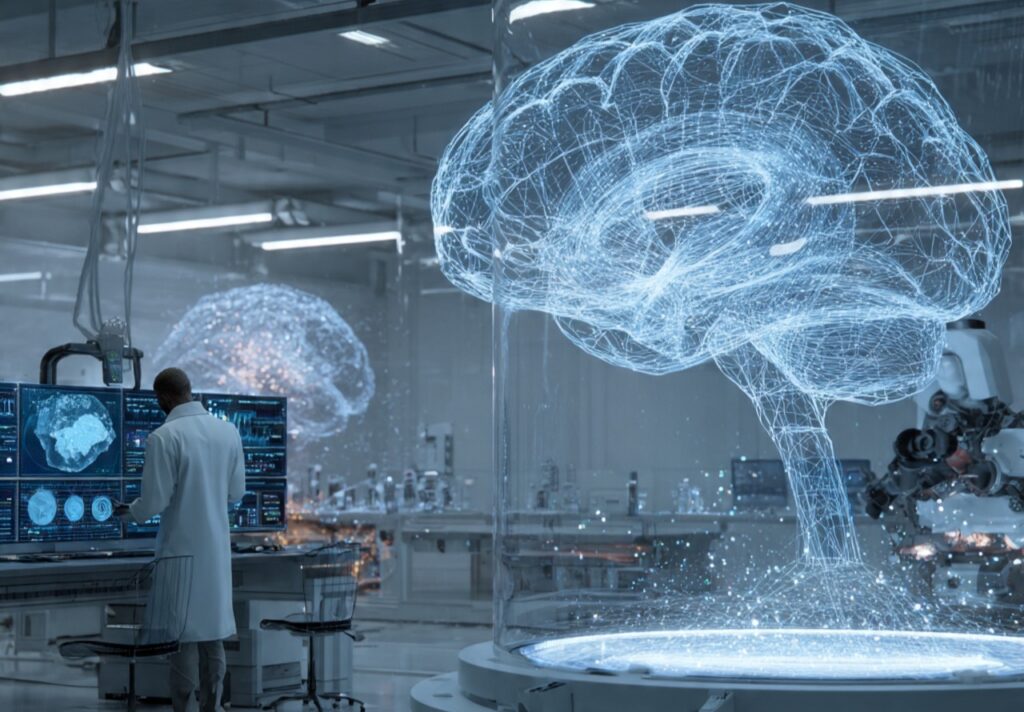
Look around you right now. Your brain instantly processes millions of pixels, recognizing faces, textures, and objects with effortless speed. For a computer, this simple act of “seeing” is one of the greatest challenges in Artificial Intelligence. This field, known as Computer Vision (CV), teaches machines not just to record an image, but to interpret, understand, and extract meaningful information from the visual world.
Therefore, CV is the core technology behind self-driving cars, instant medical diagnosis, and automated manufacturing. We will break down the precise, layered process that transforms raw light into intelligent decisions.
I. The Core Technology: The Convolutional Neural Network (CNN)
The revolution in computer sight was primarily driven by a specific type of machine learning model: the Convolutional Neural Network (CNN). Unlike older programs that required manual instructions for finding an object, CNNs learn to see on their own.
A. The Hierarchical Learning Process
A CNN breaks down the task of seeing into a multi-step, hierarchical process, mirroring how the human visual cortex works.
- Layer 1: Edges and Lines: The initial layers of the CNN look for the most basic patterns, such as horizontal and vertical lines, sharp corners, and simple color changes.
- Layer 2: Shapes and Textures: Subsequently, the next layers combine these simple lines and corners into more complex features, like circles, squares, or specific textures (e.g., fur or pavement).
- Layer 3: Parts and Objects: Finally, the deepest layers assemble these shapes into recognizable object parts—an eye, a wheel, a handle, or a window—until the network can confidently identify the entire object (a face, a car, or a coffee mug).
B. The Power of Filters (Kernels)
CNNs achieve this layered learning using filters (also called kernels).
- The Sliding Window: A filter is a small numerical grid that slides over every part of the input image. In essence, this filter acts like a mini magnifying glass, checking for the presence of a specific feature, like a diagonal line.
- Feature Maps: When the filter finds the feature it is looking for, it highlights that area, creating a feature map. Therefore, by using many different filters, the CNN generates multiple feature maps, capturing all the key characteristics of the image simultaneously.
II. The Computer Vision Pipeline: From Pixels to Decisions
Teaching a computer to interpret an image is a detailed, sequential process that follows several critical steps before the final decision is made.
A. Image Acquisition and Preprocessing
The process begins by capturing the visual data and preparing it for the model.
- Data Capture: Visual data can come from any source: a smartphone camera, a medical MRI machine, or a drone’s lens. However, the raw data is often imperfect.
- Cleaning the Image: Consequently, the image must be preprocessed. This involves enhancing the quality by removing digital “noise,” adjusting the brightness and contrast, and resizing the image to a standardized dimension required by the CNN.
B. Segmentation and Feature Extraction
This stage is where the computer starts to identify what is where in the image.
- Image Segmentation: This process divides the image into meaningful parts, either by outlining every single object (Instance Segmentation) or by simply labeling every pixel with its category (e.g., labeling all road pixels as ‘road’—Semantic Segmentation).
- Feature Extraction: Following segmentation, the model extracts the relevant features (the colors, edges, and textures) needed to classify the objects.
C. Recognition and Interpretation
This is the ultimate goal: the machine making an informed decision.
- Classification: The final layers of the CNN take all the extracted features and assign a class label to the object, such as “car,” “dog,” or “tumor.”
- Decision-Making: Ultimately, the computer uses this information to act: for example, the self-driving car system knows to brake because it has classified the object as a “pedestrian.”
III. Real-World Applications: Seeing is Automating
Computer Vision is not theoretical; it is already integrated into essential daily functions across virtually every major industry.
A. The Automotive Industry: Safety and Navigation
- Self-Driving Cars: CV systems detect lanes, traffic signs, other vehicles, and pedestrians in real-time, thereby enabling safe and autonomous navigation.
- Driver Assistance: In addition, features like blind-spot monitoring and automatic parking rely entirely on computer vision to interpret the car’s surroundings.
B. Healthcare and Diagnostics
- Medical Imaging: CV analyzes X-rays, CT scans, and MRIs with incredible speed, helping doctors detect subtle signs of diseases like cancer earlier than the human eye might catch them.
- Surgical Assistance: Furthermore, vision systems guide robotic surgical tools with high precision, improving patient outcomes.
C. Manufacturing and Quality Control
- Defect Detection: In factories, high-speed cameras powered by CV inspect products on the assembly line, immediately identifying tiny flaws, misalignments, or missing components. Consequently, this ensures consistent product quality far beyond what human inspection teams can achieve.
In conclusion, Computer Vision is transforming the physical world by giving machines the gift of sight. The field is constantly advancing, promising an era of automation, increased safety, and unparalleled analytical capability based on visual data.