
How Students Can Make Money with AI Blogging
AI blogging is one of the most practical and scalable ways for students to start earning online. Unlike freelancing, where income depends on time, blogging allows students to build a long-term asset that generates income continuously. The combination of artificial intelligence and search engine optimization has made it possible for beginners to enter blogging without years of writing experience. However, success in AI blogging does not come from simply generating content. It comes from understanding strategy, consistency, and how to turn content into value for readers.
For a broader perspective on how AI aligns with long-term careers, it is useful to explore https://digestblog.com/ai-proof-software-careers/, which explains how content creation and strategic thinking remain valuable skills even in an automated world.
Understanding AI Blogging as an Income Model
AI blogging works by creating valuable content that attracts traffic from search engines. Once people visit your website, you can earn through advertisements, affiliate links, or digital product sales. AI tools assist in writing, structuring, and optimizing content, but the direction and usefulness of the content depend on the student. This means that AI speeds up the process, but it does not replace thinking or strategy.
The key idea is simple. You create content that answers questions people are already searching for. Over time, as your content ranks on search engines, it starts bringing consistent traffic. This traffic then converts into income.
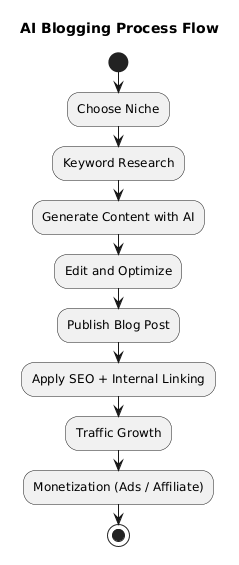
Step 1: Choosing the Right Niche
The first and most important step is selecting a niche. Many beginners make the mistake of writing about random topics, which leads to poor growth. Instead, you should choose a focused niche such as AI tools, student productivity, technology trends, or online earning methods. A clear niche helps search engines understand your website and improves ranking potential.
If you already have multiple posts on your website, this is where internal linking becomes powerful. For example, if you have written about deep learning, productivity apps, or AI tools, you can connect those posts within your blog. This creates a strong content structure and keeps users engaged longer.
Step 2: Setting Up Your Blog
After selecting a niche, the next step is setting up your blog. This involves choosing a domain name, hosting, and a simple website design. Platforms like WordPress are commonly used because they are flexible and beginner-friendly. The goal is not to create a perfect design but to create a clean and readable platform where content can be published consistently.
At this stage, many students overthink design and delay publishing. However, blogging success depends more on content than appearance. Therefore, it is better to start simple and improve gradually.
Step 3: Keyword Research and Content Planning
Before writing any article, you need to understand what people are searching for. This is where keyword research becomes important. Instead of guessing topics, you identify search queries and create content around them. For example, topics like AI tools, productivity apps, or student income ideas are frequently searched.
AI can assist in generating ideas, but you should refine them based on search intent. Planning multiple articles in advance helps maintain consistency and ensures that your blog covers a wide range of related topics. This also allows you to create internal links between posts, which improves SEO performance.
Step 4: Writing SEO-Optimized Content with AI
AI tools can generate content quickly, but raw output is never enough. The real work begins after generation. You need to edit, restructure, and personalize the content to make it readable and useful. Search engines prioritize content that provides real value, not just keywords.
A well-written article should include a clear introduction, detailed explanation, and logical flow. Transition words improve readability, while proper formatting makes the content easier to understand. The focus keyword should appear naturally throughout the article without overuse.
For additional practice and data-driven content ideas, you can explore https://www.kaggle.com/datasets, which provides real datasets that can be turned into insights and blog topics.
Step 5: Publishing Consistently
Consistency is one of the biggest factors in blogging success. Publishing one or two articles is not enough. You need to build a content library over time. Search engines favor websites that are regularly updated and provide fresh content.
In the beginning, results may not appear immediately, which often discourages students. However, blogging is a long-term strategy. Articles written today may start ranking after several weeks or months. Therefore, consistency is more important than immediate results.
Step 6: Monetizing Your Blog

Once your blog starts receiving traffic, you can begin monetization. The most common methods include advertisements, affiliate marketing, and selling digital products. Advertisements generate income based on views, while affiliate marketing earns commissions by promoting products or tools.
For example, if you write about AI tools, you can include affiliate links to those tools. When readers sign up through your link, you earn a commission. Over time, as traffic increases, these small earnings grow into a consistent income stream.
Step 7: Scaling Your Blogging Income
After gaining some traction, the focus shifts to scaling. This involves creating more content, targeting competitive keywords, and improving existing articles. You can also expand into related topics and build a complete content ecosystem.
Internal linking becomes even more important at this stage. Connecting articles across your website improves navigation and helps search engines understand your content structure. Additionally, updating old articles keeps them relevant and improves rankings.
Earning Potential and Time Investment
AI blogging does not provide instant income, but its long-term potential is significant. In the first one to three months, earnings are usually low or zero because traffic is still growing. Between three to six months, small income may start appearing as articles begin ranking. After six months to one year, consistent traffic can generate stable income.
The real value of blogging lies in its scalability. Unlike freelancing, where income depends on hours worked, blogging allows you to earn from content created once. Over time, a well-maintained blog can generate income passively without constant effort.
Common Mistakes Beginners Should Avoid
Many students fail in AI blogging because they rely completely on AI-generated content without editing. This results in generic and low-quality articles that do not rank. Another common mistake is inconsistency. Publishing a few articles and then stopping prevents growth. Some students also ignore keyword research, which leads to writing content that no one searches for.
Avoiding these mistakes requires discipline and a focus on long-term growth rather than quick results.