
Object Detection in Computer Vision: How Machines Learn to See and Identify the World
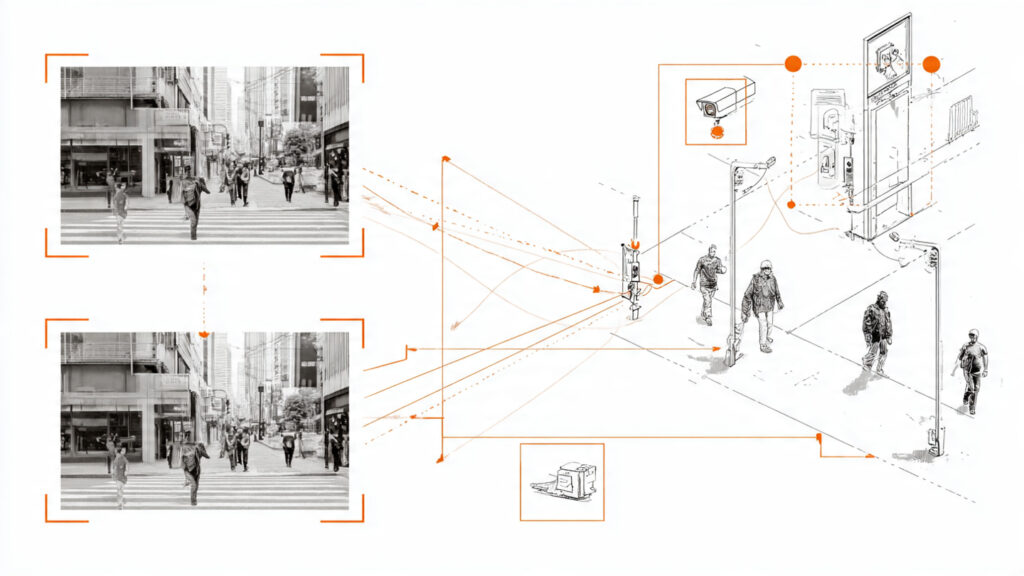
Object detection in computer vision sits at the heart of modern artificial intelligence. It is the reason machines can drive cars, assist doctors, monitor cities, and understand images beyond surface-level recognition. While many people casually mention object detection as just another AI feature, its depth, complexity, and real-world importance are often underestimated.
Unlike simple image classification, object detection forces machines to deal with reality as it actually is—messy, crowded, unpredictable, and dynamic. Real images rarely contain one clear subject. Instead, they include multiple objects, partial views, occlusions, and varying lighting conditions. Teaching a machine to navigate this chaos is no small task.
This article does not skim the surface. Instead, it explores object detection in computer vision from the ground up—conceptually, technically, and practically. You will understand not just what object detection is, but why it works, where it fails, and how it continues to evolve.
Understanding Object Detection at Its Core
At its most basic level, object detection in computer vision answers two essential questions:
- What objects are present in an image?
- Where exactly are those objects located?
These two questions may sound simple, but together they create one of the most demanding problems in artificial intelligence.
Object detection systems take an image or video frame as input and produce structured output. This output usually consists of bounding boxes drawn around detected objects, class labels describing what each object is, and confidence scores indicating how sure the model is about each prediction.
What makes this task difficult is not identifying objects in isolation, but identifying many objects at once, often under imperfect conditions.
Why Object Detection Is Fundamentally Different from Seeing
Humans detect objects effortlessly. We instantly recognize a car, a person, or a bicycle without consciously thinking about shapes, pixels, or boundaries. However, machines do not have this intuition.
For a computer, an image is nothing more than a grid of numbers. Every color, shadow, and texture must be translated into mathematical patterns. Therefore, object detection is not about eyesight—it is about pattern recognition at scale.
Moreover, object detection requires spatial understanding. The system must distinguish between background and foreground, separate overlapping objects, and identify edges accurately. This spatial reasoning makes object detection far more complex than classification.
The Evolution of Object Detection
Object detection did not appear fully formed. Instead, it evolved through multiple generations of techniques.
Early Rule-Based Methods
Early object detection relied on handcrafted rules. Engineers manually designed features such as edges, corners, and color histograms. These systems worked in controlled environments but failed in real-world scenarios.
Feature-Based Learning Approaches
Later, methods such as Haar cascades and HOG (Histogram of Oriented Gradients) improved detection accuracy. These techniques enabled early face detection systems but still lacked generalization.
Deep Learning Revolution
The real breakthrough came with deep learning. Convolutional neural networks allowed machines to learn features automatically from data. As a result, object detection became more accurate, scalable, and adaptable.
This shift transformed object detection in computer vision from a research problem into a practical technology.
How Object Detection Systems Actually Work
Although modern object detection models vary in architecture, they follow a general pipeline.
Image Representation and Preprocessing
Images are resized and normalized before being fed into the network. This ensures consistent input dimensions and numerical stability.
Feature Extraction Using CNNs
Convolutional layers scan the image to detect low-level features like edges and textures. As layers deepen, they capture higher-level patterns such as shapes and object parts.
Region Proposal or Dense Prediction
At this stage, the model identifies regions where objects might exist. Some models generate region proposals, while others predict bounding boxes directly across the image.
Bounding Box Regression
The model predicts precise coordinates for each bounding box. These coordinates define the object’s location within the image.
Object Classification
Each bounding box is assigned a class label. Confidence scores help filter unreliable detections.
Non-Maximum Suppression
Overlapping detections are reduced so that each object appears only once. This step prevents duplicate bounding boxes.
Bounding Boxes: The Language of Object Detection
Bounding boxes are rectangular frames that enclose detected objects. They may seem simple, but their accuracy is critical.
A poorly aligned bounding box can mislead downstream systems. For example, in autonomous driving, an incorrect box around a pedestrian can result in delayed braking.
Therefore, bounding box precision is a key performance metric in object detection in computer vision.
Major Object Detection Architectures Explained
Several architectures dominate the field today, each with its own philosophy.

R-CNN Family
Region-based Convolutional Neural Networks introduced the idea of separating region proposal from classification. Faster R-CNN improved speed by integrating region proposals directly into the network.
These models are highly accurate but computationally expensive.
YOLO (You Only Look Once)
YOLO treats object detection as a single regression problem. Instead of proposing regions, it predicts bounding boxes and classes directly.
This approach enables real-time detection, making YOLO popular in robotics and surveillance.
SSD (Single Shot Detector)
SSD balances speed and accuracy. It detects objects at multiple scales, making it effective for varied object sizes.
Each architecture reflects different trade-offs between speed, accuracy, and resource usage.
Training Object Detection Models
Training an object detection model requires careful planning.
Dataset Annotation
Images must be labeled with bounding boxes and class names. This process is labor-intensive and often the most expensive part of training.
Loss Functions
Object detection uses multi-part loss functions that penalize:
- Incorrect classification
- Poor localization
- False detections
Balancing these losses is crucial.
Hardware Requirements
Training typically requires GPUs or specialized accelerators. Large datasets and deep models demand significant computational power.
Evaluation Metrics in Object Detection
Unlike simple accuracy, object detection uses advanced metrics.
Intersection over Union (IoU)
IoU measures how well a predicted bounding box overlaps with the ground truth. Higher IoU indicates better localization.
Precision and Recall
Precision measures correctness, while recall measures completeness. Both are essential for reliable detection.
Mean Average Precision (mAP)
mAP summarizes detection performance across multiple classes and thresholds. It is the standard benchmark metric.
Real-World Applications in Detail
Autonomous Driving Systems
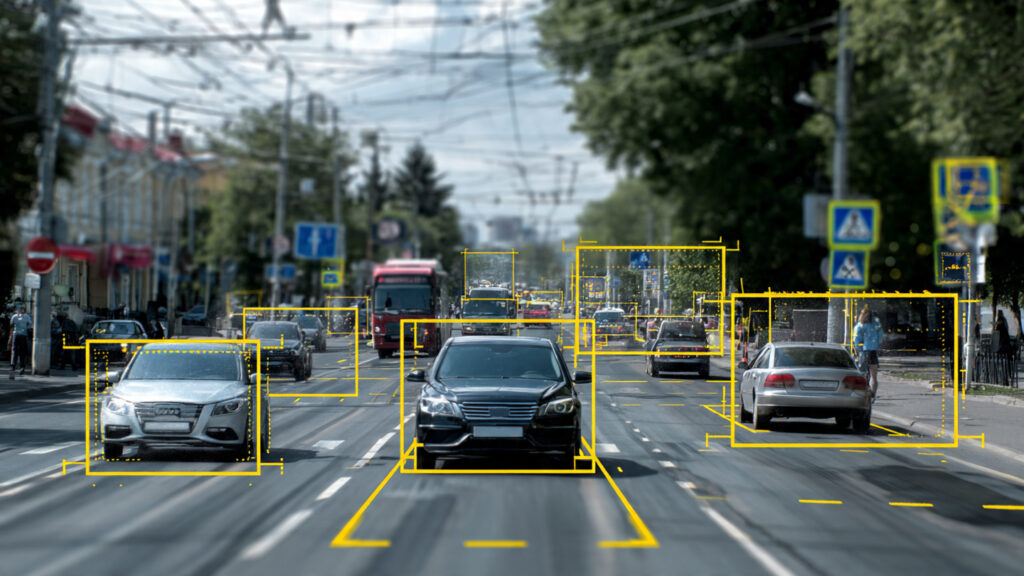
Self-driving cars rely on object detection in computer vision to identify vehicles, pedestrians, traffic signs, and obstacles. The system must operate in real time and adapt to changing environments.
Medical Diagnosis

Object detection assists doctors by highlighting abnormalities in medical scans. Early detection of tumors can significantly improve patient outcomes.
Smart Cities
Traffic monitoring, crowd analysis, and incident detection all depend on accurate object detection systems.
Retail Analytics
Stores use object detection to track customer movement, optimize layouts, and prevent theft.
Challenges That Still Exist
Despite progress, object detection is not perfect.

Small and Distant Objects
Detecting small objects remains difficult due to limited visual information.
Occlusion and Clutter
Overlapping objects confuse models, especially in crowded scenes.
Bias in Training Data
Models trained on biased datasets can perform poorly in diverse environments.
Energy and Efficiency Constraints
Deploying object detection on edge devices requires optimized models.
Ethical and Social Implications
Object detection raises important ethical questions.
- Surveillance can threaten privacy
- Facial detection can enable misuse
- Biased systems can reinforce inequality
Responsible development requires transparency, regulation, and accountability.
The Future of Object Detection
Future systems will go beyond bounding boxes.
- 3D object detection will improve spatial understanding
- Multi-modal models will combine vision and language
- Edge AI will enable real-time detection on small devices
As AI evolves, object detection in computer vision will become more context-aware and intelligent.
Learning Object Detection as a Skill
If you want to master object detection:
- Learn Python and linear algebra
- Understand CNN architectures
- Practice with real datasets
- Experiment with open-source models
- Focus on understanding, not shortcuts
Depth matters more than speed.
Conclusion
Object detection in computer vision is not just a technical feature—it is a fundamental capability that allows machines to interpret the visual world. By identifying and locating objects, AI systems move closer to meaningful perception.
From healthcare and transportation to security and retail, object detection continues to reshape industries. While challenges remain, progress is rapid and ongoing.
Understanding object detection deeply is not optional anymore. It is essential for anyone serious about artificial intelligence and the future it is creating.