
Prioritization Skills in Fast-Moving Companies
Fast-moving companies don’t fail because they lack ideas. They fail because everything feels urgent, and no one knows what truly matters right now. In such environments, prioritization isn’t a soft skill—it’s a survival skill.
When markets shift quickly, customer demands evolve overnight, and competitors move aggressively, companies that cannot prioritize lose focus, burn resources, and exhaust teams. On the other hand, organizations with strong prioritization skills move faster because they do fewer things—but do them better.
This article breaks down how prioritization really works in fast-moving companies, why it’s difficult, and how teams and leaders can master it using practical strategies and real tools.
Why Prioritization Becomes Hard in Fast-Moving Companies

Speed creates pressure. Pressure creates noise. And noise makes prioritization difficult.
In fast-moving companies, new opportunities appear daily—feature requests, partnerships, marketing ideas, urgent bugs, investor demands. Without clear prioritization, teams react instead of execute.
The biggest challenge is not choosing what to do. It’s choosing what not to do, even when those things seem important.
Common causes include:
- Constant context switching
- Fear of missing out on opportunities
- Lack of clarity on company goals
- Too many stakeholders pulling in different directions
When everything is labeled “high priority,” nothing truly is.
Prioritization as a Strategic Skill, Not a To-Do List

Many people confuse prioritization with task management. In fast-moving companies, prioritization happens before tasks are created.
Strong prioritization answers deeper questions:
- Does this move the company forward now?
- Is this aligned with current goals?
- What happens if we delay or drop this entirely?
Teams that prioritize well don’t just manage workload—they protect focus.
This is why prioritization must be tied to strategy, not urgency.
Aligning Priorities With Company Direction
Fast-moving companies often change direction, but priorities must still align with the current strategic focus.
If the company goal is user growth, priorities should favor acquisition and onboarding—not internal perfection. If the goal is retention, priorities should shift toward reliability, support, and user experience.
A simple alignment check many high-performing teams use:
“If we complete this perfectly, does it clearly support our current objective?”
If the answer is unclear, it’s likely not a priority right now.
The Cost of Poor Prioritization
Poor prioritization doesn’t just slow work—it creates hidden damage.
Teams experience:
- Burnout from constant urgency
- Low morale due to unclear success criteria
- Missed deadlines despite long hours
- Shallow execution across too many initiatives
In fast-moving companies, this cost compounds quickly. Speed without prioritization leads to motion without progress.
Proven Prioritization Frameworks That Actually Work
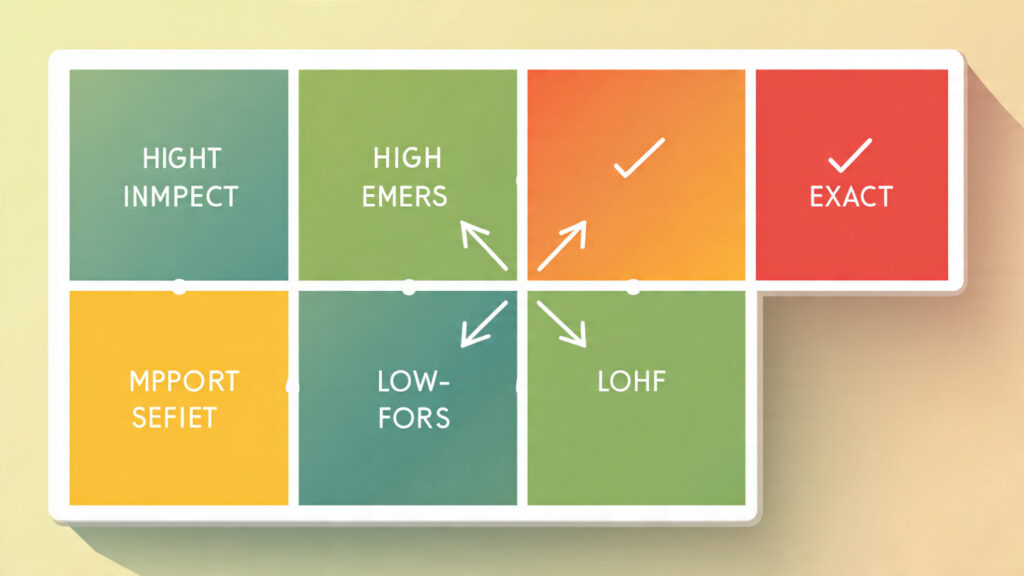
Fast-moving companies rely on simple, repeatable frameworks to cut through chaos.
Impact vs Effort Thinking
Instead of asking “Is this important?”, teams ask:
- What impact will this have?
- How much effort will it require?
High-impact, low-effort items rise naturally. Low-impact, high-effort tasks are delayed or dropped.
The Now, Next, Later Model
Rather than long roadmaps, teams define:
- Now: critical for current goals
- Next: valuable but not urgent
- Later: good ideas without current alignment
This keeps focus tight while preserving future options.
Constraints-Based Prioritization
Fast-moving companies often prioritize based on constraints:
- Limited time
- Limited people
- Limited budget
The question becomes:
“What is the best use of our most limited resource right now?”
How Leaders Drive Better Prioritization

Prioritization is contagious. Teams mirror leadership behavior.
When leaders change priorities daily, teams stop trusting priorities altogether. When leaders clearly explain why something matters, teams execute with confidence.
Effective leaders:
- Revisit priorities regularly but not impulsively
- Clearly communicate trade-offs
- Say “no” visibly and consistently
- Protect teams from unnecessary urgency
In fast-moving companies, leadership clarity equals execution speed.
Prioritization at the Team Level

Individual productivity matters, but team-level prioritization is what scales.
High-performing teams:
- Limit work in progress
- Define success criteria upfront
- Review priorities weekly, not hourly
- Make priorities visible to everyone
Tools like Notion, Asana, ClickUp, and Jira help teams visualize priorities, but tools only work when prioritization decisions are already clear.
Prioritization Under Pressure
Fast-moving companies often face crisis moments—outages, deadlines, competitor moves.
In these moments, prioritization becomes ruthless:
- What must happen today?
- What can wait without serious damage?
- What distractions must be ignored temporarily?
Teams that practice prioritization before crisis perform better during crisis.
Individual Prioritization in High-Speed Environments

Employees in fast-moving companies also need personal prioritization skills.
Effective individuals:
- Start the day with 1–3 critical outcomes
- Block time for deep work
- Reduce reactive communication
- Ask clarifying questions instead of assuming urgency
Personal prioritization prevents talented people from becoming overwhelmed contributors.
Measuring Whether Prioritization Is Working
You can tell prioritization is effective when:
- Teams finish fewer things—but with higher quality
- Deadlines become predictable
- Meetings decrease in urgency
- Work feels intentional, not chaotic
Fast-moving companies that prioritize well feel calmer than those that don’t—even while moving faster.
Common Prioritization Mistakes to Avoid
Even experienced teams fall into traps:
- Treating loud requests as important ones
- Overloading roadmaps
- Confusing activity with progress
- Avoiding hard trade-off conversations
Recognizing these patterns early prevents long-term damage.
Why Prioritization Is a Competitive Advantage
In fast-moving markets, execution speed matters—but focused execution matters more.
Companies that prioritize effectively:
- Out-execute larger competitors
- Adapt faster to change
- Retain top talent
- Deliver consistent value
Prioritization isn’t about doing less—it’s about winning with intention.